
Pipeline Preferences: When “Adjustable” Isn’t Enough—Choosing Fittings That Truly Fit
In water works and industrial pipeline applications, many connectors and repair fittings look similar, and many will adjust to nominal pipe sizes. But the assumption that “one size fits all” can quietly translate to “fits… but not very well.” When you’re repairing or connecting critical infrastructure, the goal is long-term performance, not short-term convenience. Below is a practical checklist to help you evaluate fittings that are closer to a perfect fit for the application.
1) Design & construction: what’s behind the fitting matters
- Hoop strength support: Some pipe materials benefit from fittings that distribute load evenly around the full circumference to avoid stress concentrations.
- Structural integrity: Reinforcement features can help support semi-rigid plastics and brittle or aged pipe where extra stability is needed.
Tip: Avoid swapping fittings across pipe materials just because the diameter matches—point-loading designs (like some U-bolt saddles) can damage cast iron or deform PVC.
- Pressure ratings: Confirm the fitting’s working pressure for the specific pipe size and gap opening (see table below). For larger diameters and higher pressures/surges, a fabricated repair sleeve may be the better choice than a clamp.
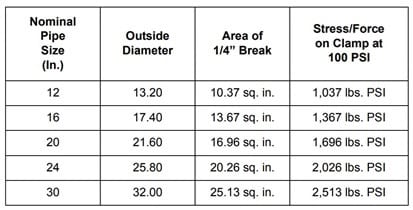
As pipeline diameters increase, the stress/force on a traditional pipe repair clamp rises dramatically. At higher pressures and larger pipe sizes, consider the capabilities of a fabricated repair sleeve tailored to the specific requirements of the application, instead.
- Material quality: Validate base materials, coatings, fasteners, gasket compounds, and standards compliance (ANSI/ASTM/AWWA)—not just exterior finish.
2) Gasket fit: sealing performance is not “one gasket fits all”
Gasket thickness and geometry drive real-world sealing. The right gasket should seal reliably while accommodating pressure changes and normal pipeline movement.
As diameter and pressure increase, sealing a large gasket surface area gets harder. An outlet seal design can often achieve higher working pressures than a full circumferential gasket because the sealing area is smaller.
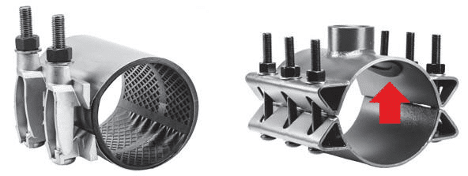
As pipe diameter and line pressure increase, the force required to seal the larger surface area of a full circumferential gasket (left) is higher than that required to seal the smaller surface area of the narrow contour outlet seal (right) indicated by the red arrow.
3) Tolerances: close-fitting components reduce risk in high-pressure work
In high-pressure work, closer-fitting components typically reduce risk by limiting stresses from pressure, dynamic forces, and ground movement.
4) Functionality: match the fitting design to the job
Consider the installation details that can make or break long-term reliability, such as:
- Engagement/overlap: Ensure adequate coupling overlap on both pipe ends—especially when field cuts create wider gaps.
- HDPE stiffeners: Use stiffeners as needed to help prevent pipe movement away from the gasket over time.
- Misalignment/deflection: If joints are significantly offset, choose designs meant for misaligned pipe—forcing alignment can stress the joint and compromise the seal.
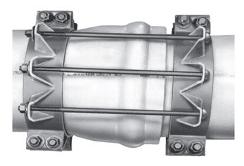
Long-bolt restrainers can help hold pipe ends together to resist flexing and loosening during installation or ground movement.
5) Installation environment: soil and climate can change what “best” looks like
Environment matters. Freeze/thaw cycles, unstable soils, and corrosive or conductive conditions can all increase movement or accelerate degradation—so specify materials, coatings, and gasket compounds accordingly.
6) “Equivalent” vs. “approved equal”: decide before the emergency
Don’t wait for a high-profile repair to decide what’s “equivalent.” Standardize approved-equal designs in advance, and involve experienced support when conditions are complex. For deeper guidance, contact us or explore training through JCM Industries University (JCMU), especially the ‘General Pipe Repair Information and Guidelines’ and ‘Pipe Material Characteristics’ courses.