
Choosing the Right Mechanical Fittings for HDPE Pipe

High-Density Polyethylene (HDPE) pipe continues to be a popular choice for water, wastewater, offshore, and industrial applications because of its corrosion resistance, chemical resistance, and versatility. From pipe bursting and slip lining projects to larger distribution and transmission systems, HDPE offers many advantages in the field.

However, HDPE also has unique working characteristics that require special attention during repair, connection, tapping, and restraint. Its dimensional tolerances differ from traditional pipe materials, and its smooth surface can make bolt-on fittings more susceptible to movement. HDPE is also sensitive to pressure and temperature changes, meaning expansion, contraction, stress, and creep all need to be considered when choosing a mechanical fitting.
At JCM Industries, we understand that not every commonly used fitting is appropriate for long-term service on HDPE pipe. That is why selecting products designed for HDPE’s specific characteristics is essential to protecting system performance, supporting long-term reliability, and making installation more efficient in challenging field conditions. Mechanical pipe fittings are used to join, seal, repair, branch, transition, or restrain pipe without welding, soldering, or threading. For HDPE systems, they can be especially valuable when additional strength, rigidity, or adaptability is needed, or when weather, site access, field conditions, or emergency circumstances make fusion difficult.
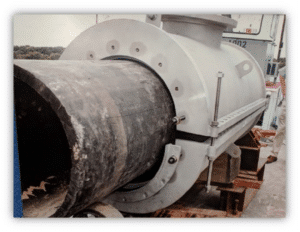
JCM offers mechanical products that help customers connect, repair, branch, and restrain HDPE pipe in a variety of potable water and pressure applications. While many common systems use HDPE SDR 17 through 11, project conditions and pressure requirements should always guide product selection:
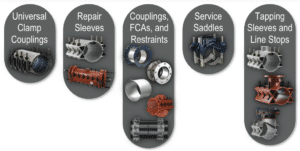
• Universal clamp couplings can serve as both repair clamps and couplings when used with appropriate restraint. Features such as stainless-steel bands, low-profile lugs, thick gridded gaskets, and wide-range capability help support reliable performance in the field.
• Repair sleeves are designed for damaged pipe, leaking pipeline appurtenances, abandoned outlets, and other complicated repair situations. These fittings can seal over holes or damaged areas while reinforcing the pipe, helping protect the long-term reliability of the system.
• Couplings and flange coupling adapters (FCAs) help join different types of pipe or adapt plain-end pipe to flanged equipment and fittings. These options are commonly used when customers need a practical transition from HDPE to other system components.
• Service saddles are well suited for HDPE when broad pressure-activated gaskets and wide stainless-steel straps are used. Wide straps spread the pressure load across a larger surface area, helping reduce issues caused by point loading. Service saddles can also be used as repair fittings for small holes or punctures when paired with the appropriate outlet closure.
• Tapping sleeves can be designed for the exact outside diameter of HDPE pipe and manufactured with a broad, pressure-activated gasket and wide body to reinforce the pipe. For HDPE tapping applications, the maximum tapping machine cutter size should be no more than 90% of the pipe’s inside diameter.
• Line stop fittings can temporarily shut down and isolate a pipeline section for repair or modification without interrupting service. Although less commonly associated with HDPE, line stops can be extremely useful in emergency applications.
HDPE pipe brings valuable advantages to modern piping systems, but its unique working characteristics make proper fitting selection critical. By understanding how pressure, temperature, movement, surface condition, and pipe wall support affect performance, project teams can choose mechanical solutions that support a stronger, more reliable installation.
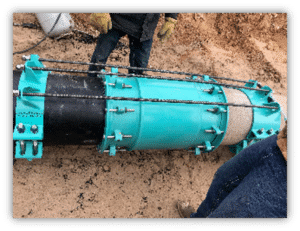
For projects involving HDPE repair, tapping, connection, or restraint, JCM Industries offers mechanical fitting solutions designed with these challenges in mind. Contact us today to discuss your application and identify the right product for your system’s needs. Learn even more on the topic by taking the ‘High-Density Polyethylene (HDPE) Mechanical Pipe Fittings’ JCMU course.